RegelRecht explores how we can deliver transparent, unambiguous and consistent execution of legislation. An exploration of digital possibilities where everyone can understand how decisions are reached.
An initiative of
Executing legislation comes with several challenges: differing interpretations, opaque systems, and complex programming work that often sits far from the original law. RegelRecht explores whether machine-executable legislation can offer an answer — laws written directly as executable code, without programmers in between.
Can we transform traditional legislation into machine-executable specifications? We are investigating whether this can narrow the gap between legislator and execution.
What if there were one central, machine-executable version of every law that all parties use? We are exploring whether this can reduce differences in interpretation.
How do we make government decisions more transparent? We are experimenting with ways for citizens to see which rules apply and how decisions are reached.
The current way laws are applied raises several challenges for the rule of law. We are investigating whether new technical approaches can contribute to solutions for these structural questions.
The same law is interpreted and applied differently by different government organisations, leading to inconsistencies and injustice.
Could machine-executable laws reduce interpretation problems? We are investigating whether this can lead to more consistent rule application.
Citizens receive decisions with no explanation of how they were reached. Government as a black box.
Can we make every decision traceable back to the exact rule that was applied? We are exploring options for more transparency in government decisions.
Laws are often written without fully testing whether they are workable in practice. This can cause implementation problems through inconsistencies, ambiguities or practical constraints.
Would machine-executable legislation make it possible to test laws? We are investigating whether inconsistencies and conflicts can be detected early.
How might the transition from traditional legislation to a digital legal system unfold? We explore seven possible steps and what each could make possible:
Can existing laws be systematically converted from analogue text into machine-executable specifications? A first step to explore a digital foundation.
Could new laws be written machine-executable from the start? We explore what that could look like and how we can support it.
A national infrastructure where all government systems use the same legal definitions. A single source of truth for rule application.
It becomes possible to work systematically on harmonising existing legislation. Conflicts and inconsistencies between existing rule sets can be detected automatically, making harmonisation a deliberate choice.
New laws can be tested before they take effect. The effect of new legislation on the consistency of the legal system can be analysed during the legislative process.
Machine-executable legislation is published centrally for everyone. Execution engines are made available too, so all parties can run the same laws in an identical way.
Citizens and businesses can inspect and verify exactly how rules work. Full transparency into rule application.
Normalized Rule Model Language — a JSON-based exchange and storage format for machine-executable laws. NRML makes complex legal logic accessible, supports multilingual rules and has built-in versioning.
Multiple execution engines that run NRML code. Different languages for different use cases — but a consistent legal result.
An LLM-based tool to convert existing analogue law into machine-executable NRML. Automatic transformation of traditional legislation into a digital legal system.
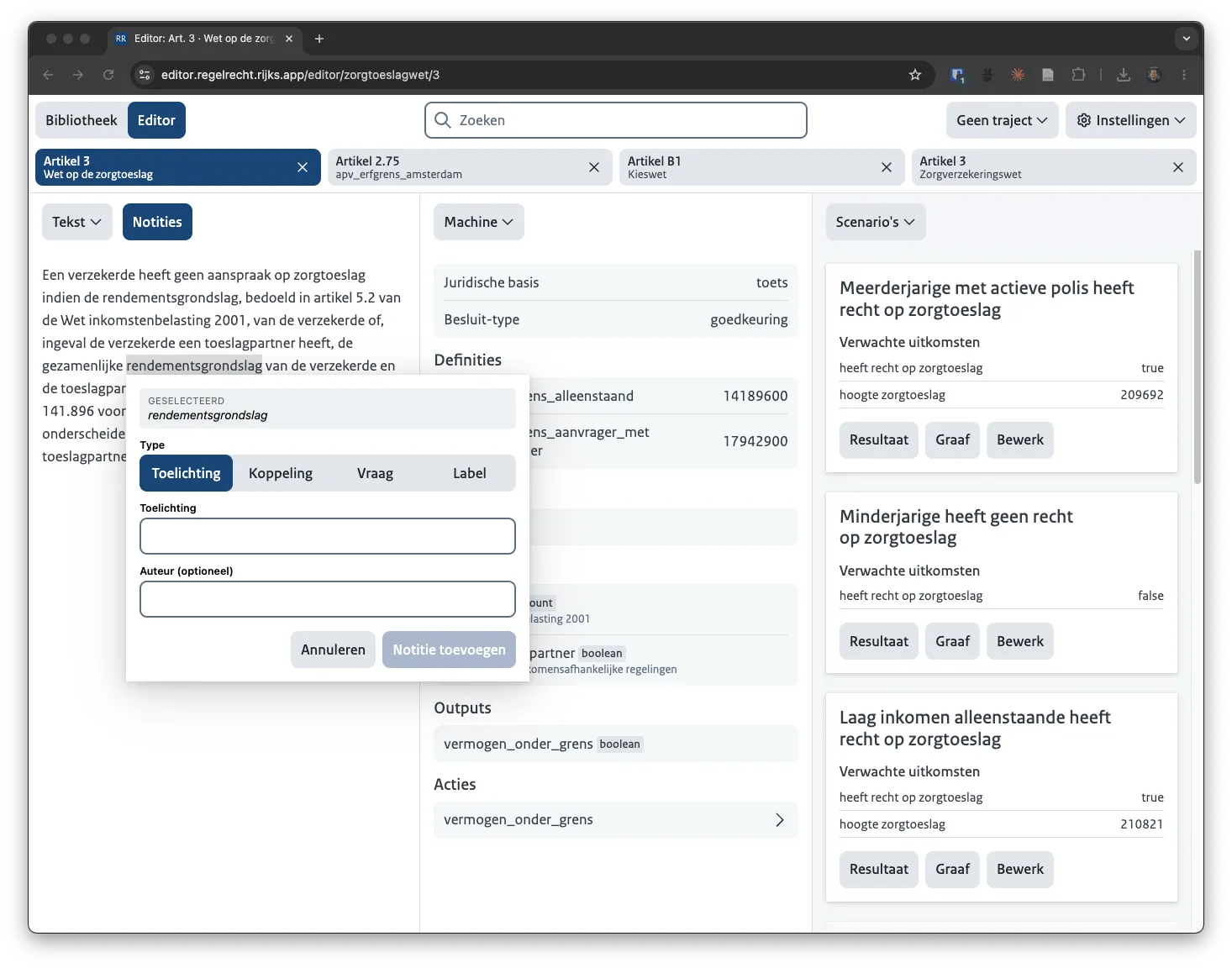
An intuitive drag-and-drop interface for legal experts to write laws without programming knowledge. From visual logic to executable code.
Visualises complex relationships between different laws. Shows how changes to one law propagate through the entire legal ecosystem.
Full versioning of machine-executable legislation. Track changes, roll back, and branch different legislative proposals.
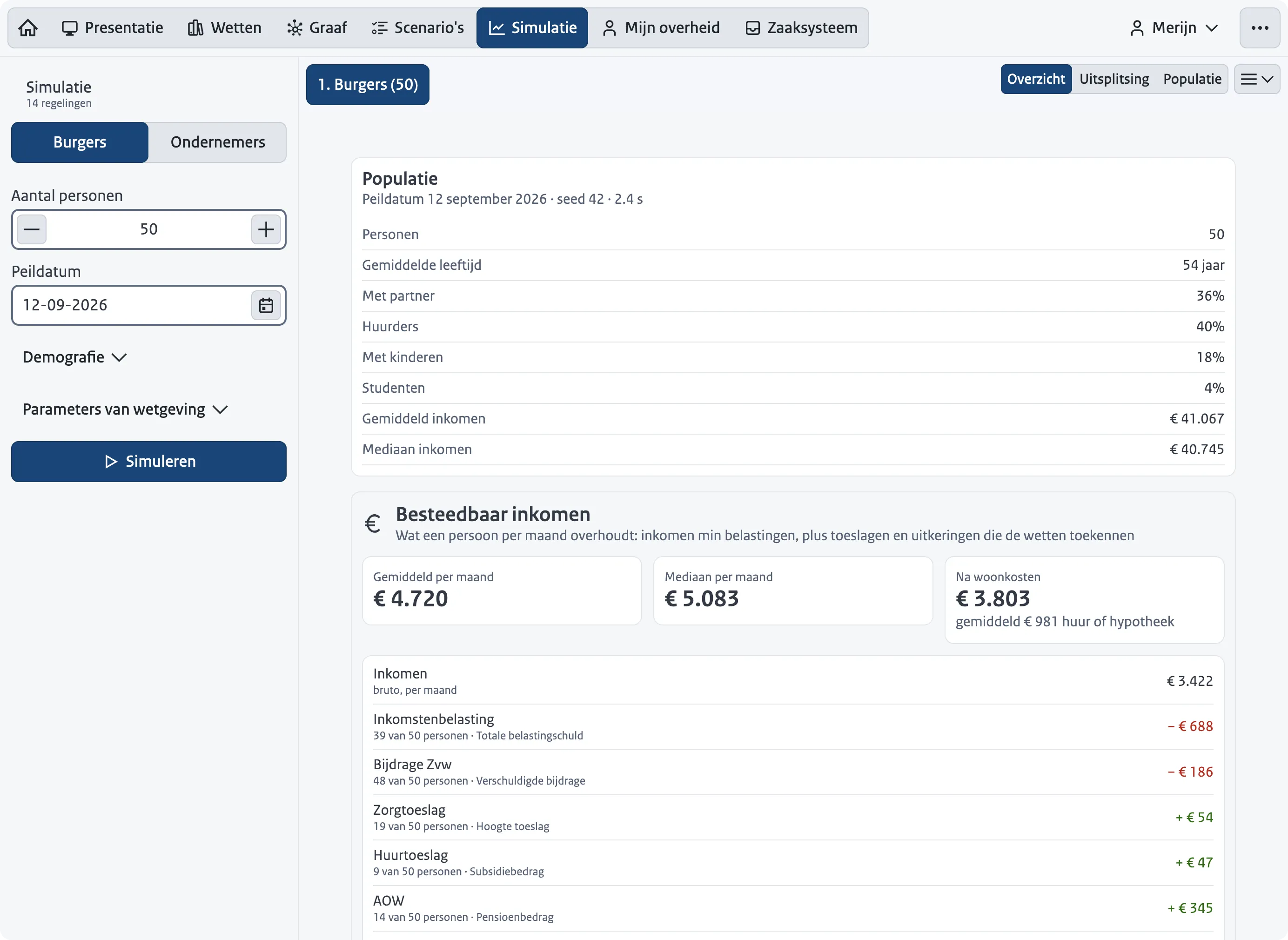
Test the consequences of new legislation before implementation. Model societal impact and predict unintended effects.
Central publication and distribution of machine-executable legislation. API access for all government systems and private parties.
What could the RegelRecht ecosystem make possible in practice? We explore two directions for transparent rule application and legislative testing.
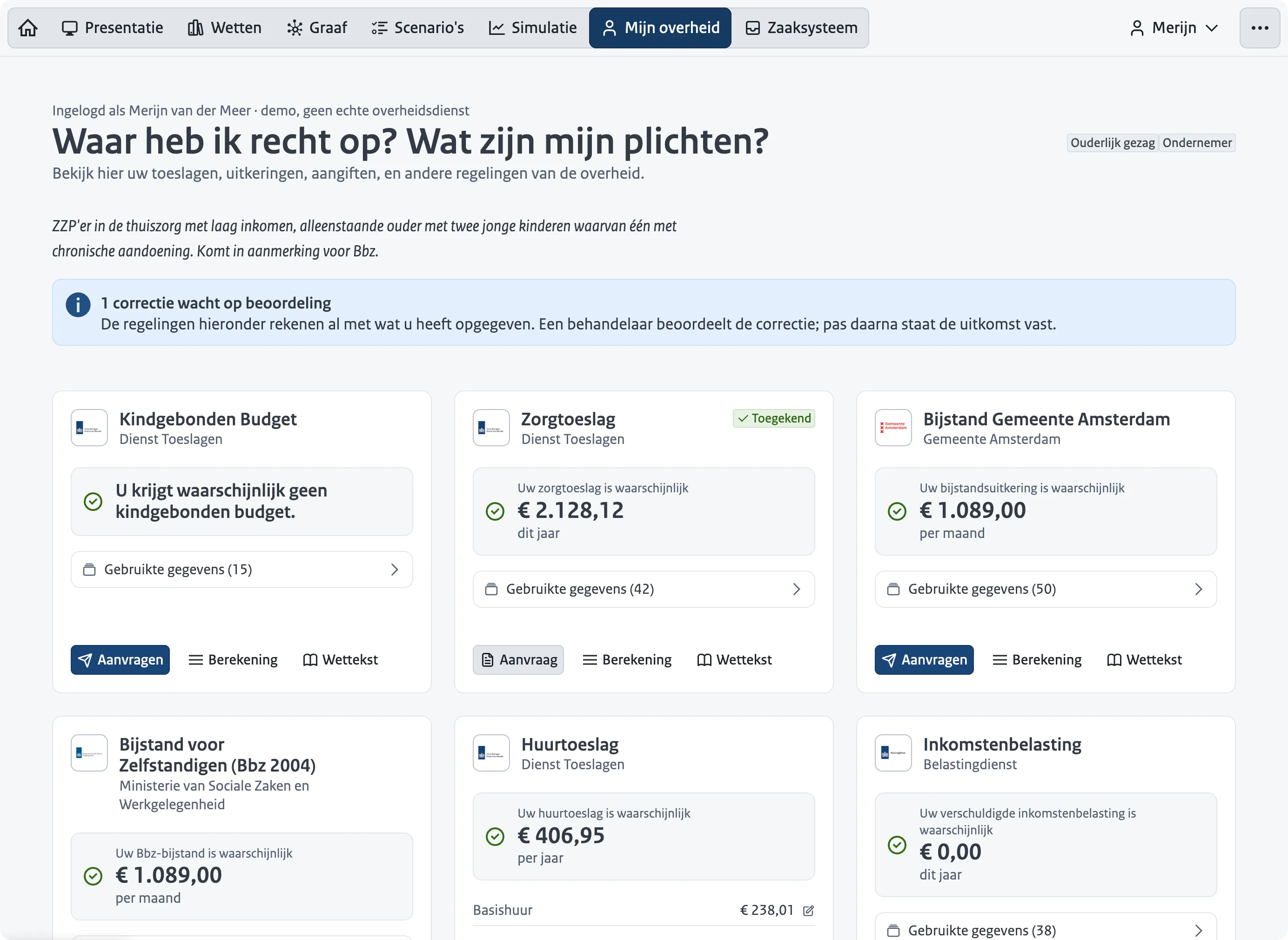
What if citizens could see all their benefits, allowances and obligations in one place? Every rule could then be traceable back to the machine-executable legislation, with full transparency about how decisions are reached.
What if policy makers could test the consequences of new legislation in a simulation environment before it is introduced? Could this prevent unintended effects and improve the quality of legislation?
RegelRecht contributes to two projects from the 2025 Innovation Budget of the Dutch Digital Government:
How do we prevent the accumulation of laws and regulations from making laws unworkable? This project explores developing an analysis tool to test legislative proposals for workability in conjunction with other laws.
Can we develop a general calculation core for government? This project explores how such a system could help execute complex schemes for citizens and businesses, for example when calculating allowances.
An overview of key reports, research and sources that underpin the need for machine-executable legislation.
This WRR factsheet identifies five points of attention and review questions for parliamentary oversight of the digital execution of legislation. The RegelRecht project falls within the scope of this factsheet and can be assessed against the proposed criteria for transparency, traceability and democratic control.
This factsheet for the House of Representatives’ Standing Committee on Digital Affairs names six rule-of-law risks of digital law execution, including opacity and translation problems between legal text and code, and argues for traceability of algorithms back to their legal source.
Zuurmond observes that current information management supports a bureaucratic, reactive government too strongly based on distrust of citizens. He argues for a responsive government with better information provision.
The Court of Audit tested 9 algorithms at various government organisations and found that 6 of them carried risks around performance management, bias, data leaks or unauthorised access. The report stresses the need for continuous monitoring.
This first systematic study of algorithm use by the Dutch government found that algorithms focus mainly on government needs, with limited attention to ethical aspects and citizen insight.
The Council of State stresses the importance of implementation assessments and collaboration between policy makers, legislative lawyers and implementing organisations in multidisciplinary teams, and argues for better testing of workability and citizens’ ability to act.
The State Commission observes that demographic developments put pressure on the accessibility of government services such as education, healthcare and housing.
The study group concludes that digitising government requires a radical change of mindset and that digital service delivery belongs at the core of the primary process.
This report analyses problems at implementing organisations such as the Tax Administration, DUO and UWV: continuity risks, limited agility when policy changes, and missing options for tailored solutions.
This action plan was drawn up in response to the 'Unprecedented injustice' report and focuses on structurally improving information management across central government.
A digital legal system could mean that legal rules are written as executable code that computers can run and apply directly, without human interpretation or programmers in between. But is this achievable? And how does it relate to traditional analogue law?
NRML stands out through a developer-friendly JSON approach instead of complex XML standards. It serves as a standard exchange and storage format so that different government systems can use the same rule specifications. NRML has built-in test scenarios and versioning.
Could RegelRecht validate existing implementations and serve as a reference for new systems? It would not replace existing systems directly, but it could make verification and modernisation possible.
RegelRecht could be a technical aid. Legal validity would remain with the original legislation. But could it help with consistent interpretation and application?
By making rules explicit in code, citizens and organisations can see exactly how decisions are reached, instead of relying on opaque systems.
This exploration of machine-executable legislation raises many questions. How do you see the future of digital government? What are your concerns and expectations around these developments? Your input helps us shape this exploration further.